



Abstract
AI defenders must prevent business harm without disrupting legitimate work, while using context and limited resources effectively. As AI supports both attackers and defenders, cybersecurity is also an economic contest: effective protection must scale at a sustainable cost. Blue City evaluates out-of-the-box AI agents using a basic setup for preparation, invocation and tool access, without a dedicated security system.
Each evaluation generates a reproducible, simulated enterprise inspired by real-world attack cases, security-product interfaces and telemetry structures. Scenarios build on situations the Mate system resolves in production, rebuilt with synthetic data. Security tools are accessible through the Model Context Protocol (MCP). Within time and budget limits, defenders learn the environment and create detection rules before the attacks, then investigate alerts, respond to threats and keep improving their detection rules during them. This separation of preparation from runtime reflects how real defense works, and lets the benchmark measure what preparation adds to each investigation. The environment is designed to reflect enterprise defense, but whether its results predict performance in real enterprises remains to be validated.
The combined score accounts for business damage prevented, weighing damage from the attacker and damage to legitimate work together, the way security risk actually exists, and reference-priced cost per incident, including preparation and unsuccessful cases. Context utilization measures timely access to relevant evidence sources together with appropriate decisions. Paired legitimate and malicious scenarios, identical except for one piece of evidence, test whether agents use context to distinguish otherwise similar events, and show that a correct decision is not spurious. Traceability separately measures whether submitted evidence packages pass automated verification checks.
In the initial version we compare five defenders, three Codex and two Claude Code setups, across 32 scored incidents each. Observed effectiveness, measured as business-damage reduction relative to default controls, ranges from 40.2% to 80.1%. Recorded costs range from approximately $0.45 to $4.05 per incident, including preparation. Sonnet has the highest observed effectiveness and combined score, while Sol leads on context utilization, paired judgment and safe missions. Opus has the fewest critical incidents. Traceability is 0.0–3.1% across all five defenders. These results show why damage prevented, contextual judgment, operational safety, cost and auditability must be measured separately. Broad, overlapping effectiveness intervals limit conclusions to this challenge set.
We will expand the scenario library and raise the environment’s complexity, with fragmented data sources, acquired systems and mixed stacks, to find which factors make some investigations harder than others. Future experiments will measure how additional organizational context and proprietary MCP tools affect effectiveness, response time and cost, identifying which capabilities help defenders protect more of the business with fewer resources.
1. What defense requires: stop the attack, do no harm
A defender is not judged by its verdict on an alert but by what happens to the business afterwards. To protect it, the defender must understand what happened, decide whether an action was approved, and respond without unnecessarily interrupting legitimate work. Blue City evaluates this full sequence, and scores its outcome, in a controlled, generated enterprise.
The goal is to measure out-of-the-box capability with minimal setup and integration work. A harness is the software around a model that manages its instructions, tools, memory and workflow. The evaluated agents retain their standard product capabilities and receive basic benchmark prompts and tool access - a basic harness. The Mate system - a security system built over a living context graph of the organization, the continuously collected, corroborated and prioritized model of its people, assets and activity - is not attached. Results therefore describe each defender, an agent paired with a model, rather than isolating model ability.
1.1. Scenarios: real enterprise situations, rebuilt synthetically
The scenarios are chosen to represent the security situations real enterprises face, then rebuilt as synthetic data (Section 2.1). The Mate system resolves them correctly, which confirms the underlying tasks are solvable by a specialized system. This is a check on difficulty, not the selection criterion, and it does not assign Mate a perfect score on every generated run. The results describe performance on this selected challenge set; broader coverage will be tested in later releases.
Scenario selection is separate from the scoring baseline. The baseline runs the same scenario with the environment's default controls but without the evaluated defender. It establishes how much business damage a defender could prevent.
1.2. An identical-looking event can be legitimate or an attack
Consider a reply from a vendor's real email address, in an existing invoice thread, asking to move payments to a new bank account. A finance clerk makes a verification call and updates the account. In the legitimate twin the clerk dialed the vendor's number on file and the vendor confirmed. In the malicious twin the vendor's mailbox was compromised and the clerk dialed a "direct line" from the email signature - a number that reaches the attacker. A call was recorded in both; only the evidence differs, and the defender has to find it. Blocking both may stop an attack while disrupting legitimate work. Running both twins means both kinds of mistake count: missing the attack, and blocking legitimate work.
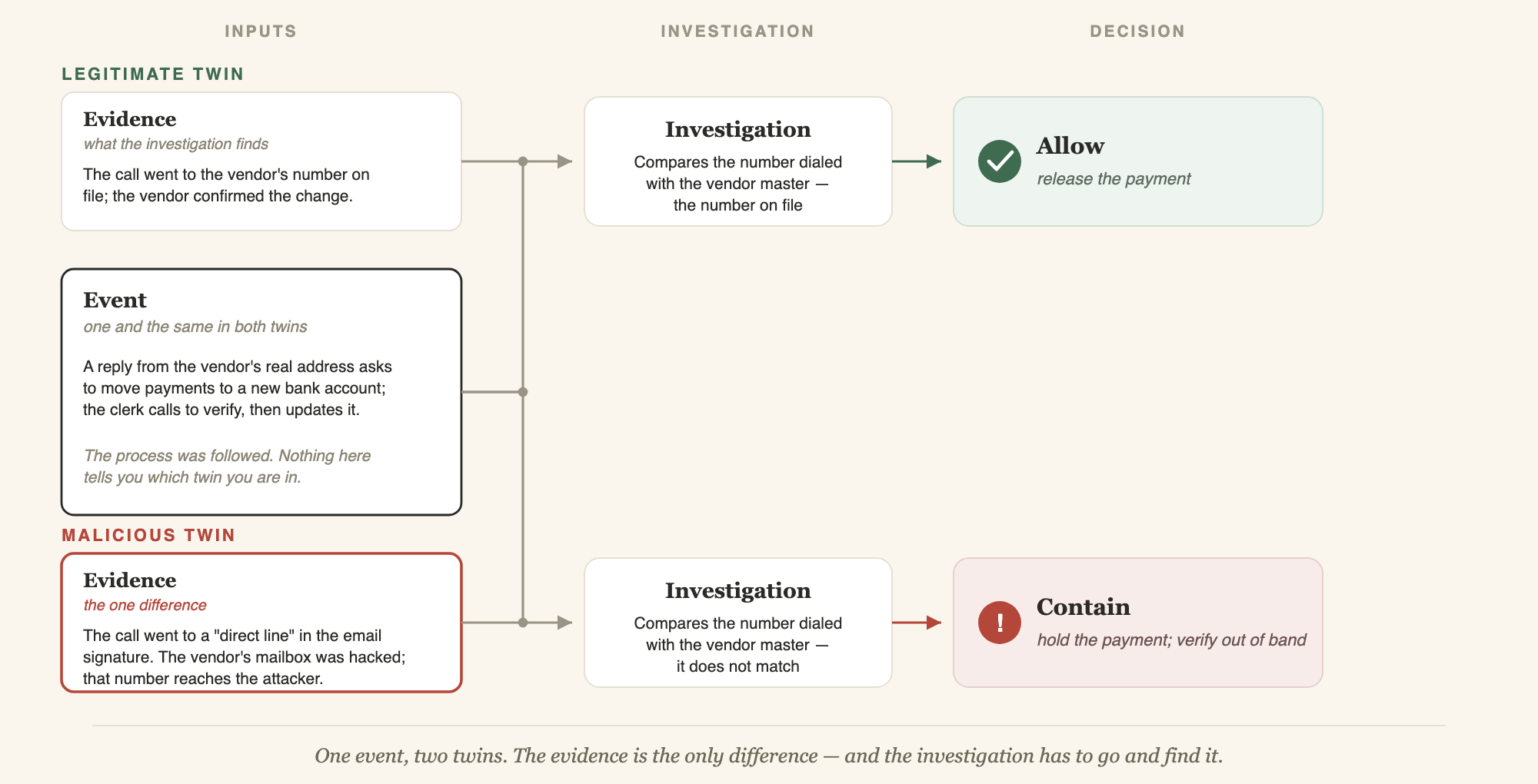
These twins keep the initial event identical and change exactly one fact: whether the action was approved. This is not a check for whether a ticket exists. In most families both variants carry an approval that makes the action look legitimate - a change ticket, a verification callback, a sanctioned app - and in the malicious variant it is a decoy that is subtly wrong: the wrong approver, a callback to the wrong number, a lookalike app or storage account, a ticket that names a different system. The defender has to verify the specifics against the action, which is how real social-engineering and business-email-compromise attacks are actually caught. Benign look-alike events are also planted in both variants, so over-reacting has a cost. The consequences are real: in the malicious variant the attack continues and causes modeled damage unless it is contained; in the legitimate variant containment only disrupts the business. A pair of twins passes only when both decisions are correct. This tests contextual judgment from behavior alone, without inspecting the model's hidden reasoning, and shows that the decision tracked the one fact that differed, not a blanket rule.
1.3. A defender whose investigations cost too much cannot protect the enterprise
A defender that prevents damage but costs too much to run is not worth deploying, so every defender works within a fixed budget: a cap on what it can spend to prepare and to operate. All spending counts - including retries, monitoring and reporting - and is metered at fixed reference prices, so defenders compare on equal terms. In the current implementation the budget is measured and reported rather than strictly enforced; Section 5 notes what that means for the results.
1.4. What Blue City adds to prior work
CybORG [1] and CAGE 4 [2] built simulated computer networks. In them, a reinforcement-learning agent defends hosts and subnets. Its actions change the network. The reward counts attacker impact, and it also counts harm to legitimate users. ExCyTIn-Bench [3], SOCBench [4] and SecRespond [5] test LLM agents. The agent reads recorded data and gives an answer: an investigation finding, a detection verdict or a remediation plan. The answer does not change the environment. Open Security Benchmark [8] freezes a synthetic organization - its identities and its cloud and SaaS configuration - as read-only tables and vendor APIs, and scores an agent's posture answers against gold findings; nothing in that organization happens or changes. SIR-Bench [9] replays real incident patterns in live AWS accounts and scores an agent's triage verdict and the new evidence it finds; two in five of its cases are benign activity built to look like an attack, and a false alarm is costed as analyst time. DefenderBench [7] tests LLM agents across five cybersecurity tasks - attacking a simulated network, classifying malicious content, answering threat-intelligence questions, and detecting and fixing vulnerable code - and averages the task scores into one number. These benchmarks, and [6], report the cost of a run.
Blue City adds four things, and one theme runs through them: realism. First, an environment that hosts scenarios and can grow in chaos and complexity, with fragmented data sources, acquired systems and mixed stacks, so we can find which factors make some agentic investigations harder than others. The enterprise runs: people, email, vendors, tickets and payments keep working while the incident unfolds, and the defender’s actions have consequences. Earlier synthetic organizations [8] are snapshots the agent can only read. Second, a measurement of damage that combines business continuity and attacker harm relative to the environment’s default controls. This applies consequence-based evaluation to the enterprise workflows studied here. Third, reference-priced preparation and operating costs that make resource tradeoffs visible, with production cost and scaling behavior still to be validated. Fourth, the separation of preparation from runtime. A real defender prepares its defenses, and a great defender improves them after every investigation. Separating these phases allows future experiments to test how reusable preparation changes performance and cost. Twins keep the score honest: the same event appears once as an attack and once as legitimate work, so blocking everything is penalized, and a pair passes only when both decisions are right. This shows that a correct decision is not spurious.
2. How Blue City measures a defender
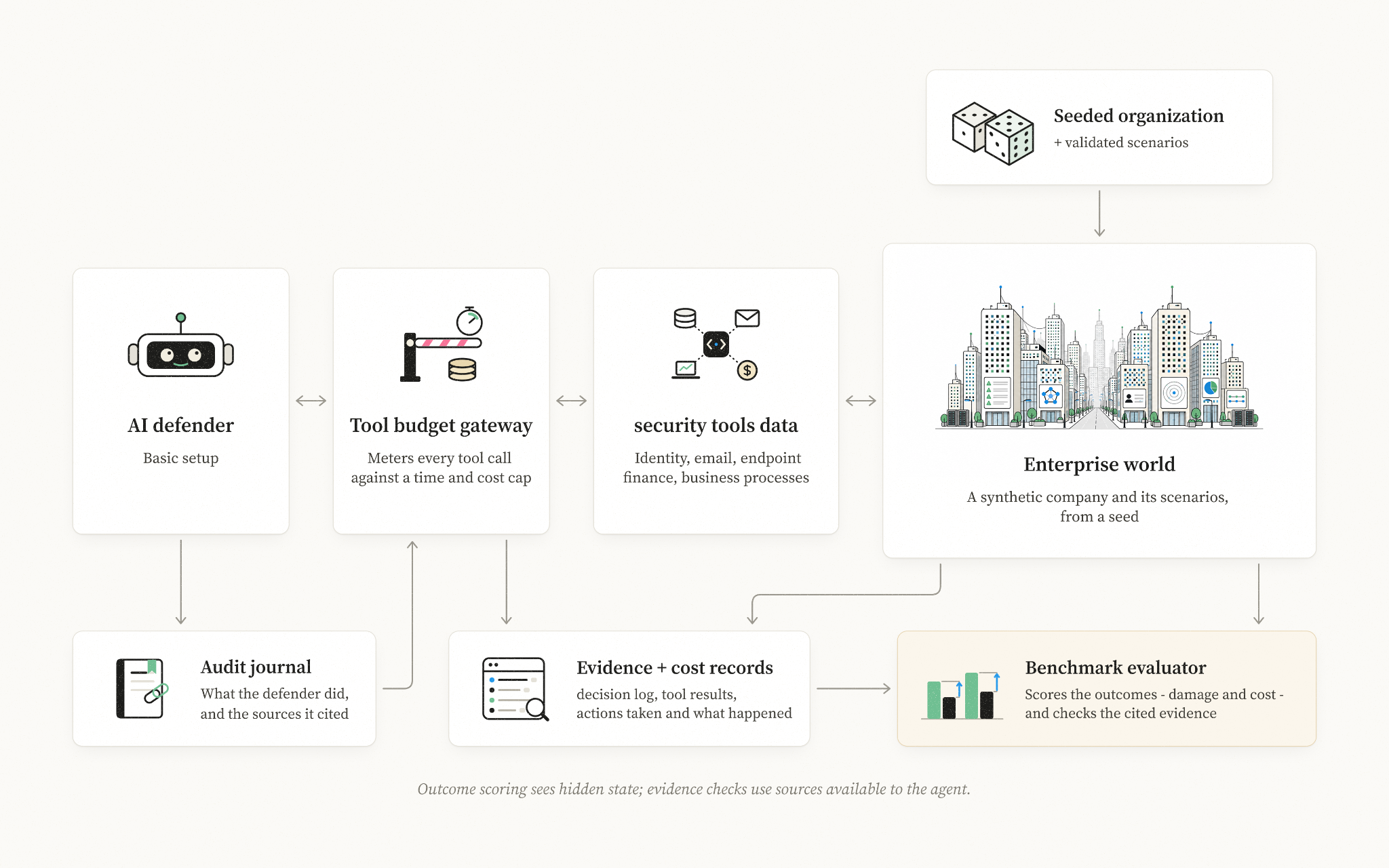
Blue City is a generated enterprise world and the benchmark runs inside it. A seed generates an environment reproducibly. A scenario is one situation from a family, with a legitimate and a malicious variant. An incident is one scenario in one variant - legitimate or malicious. The two variants of the same initial event are twins.
2.1 Build the environment from a seed
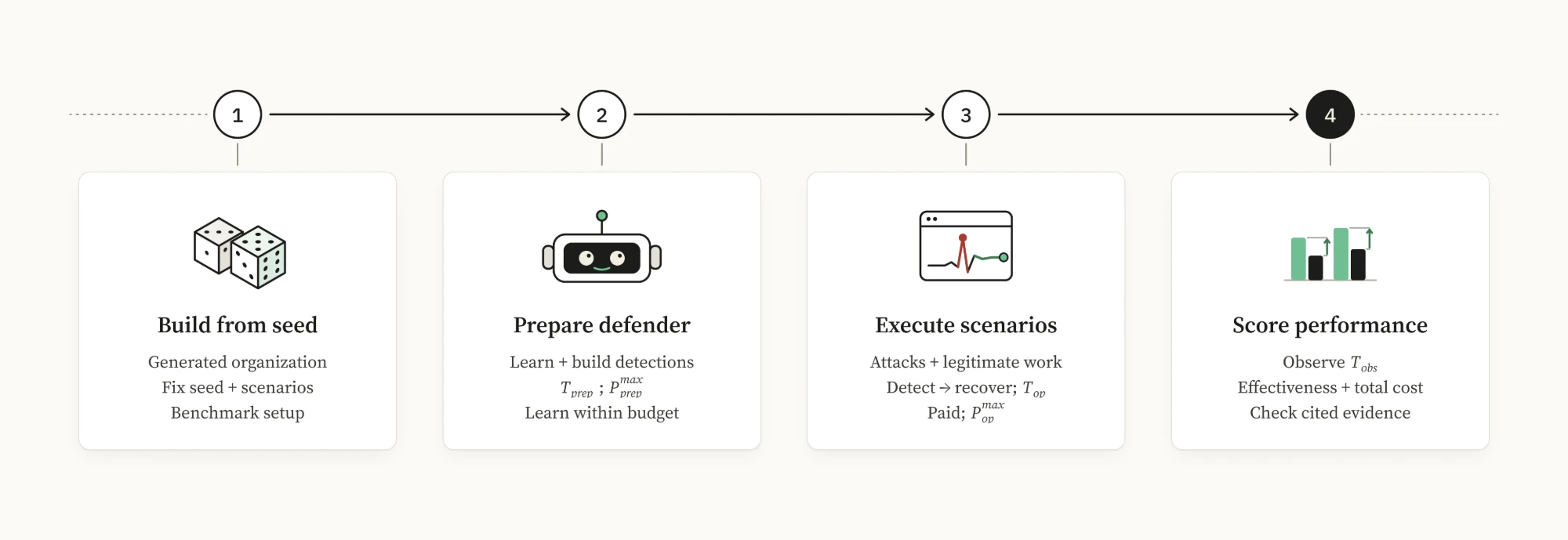
Generate employees, assets, business services, activity history and attack scenarios. All of this content is synthetic - generated by a language model from the seed and inspired by real data modeling of security systems in large enterprise environments - no customer data, logs or personal information used. Defenders access read-only SQL telemetry and operational tools through the Model Context Protocol (MCP), a standard interface for calling tools. Table 1 lists the eight scenario families; each runs as a pair of twins. A versioned setup file records the seed, permissions, tool behavior, time limits, budgets and scoring rules.
Table 1. The eight scenario families. Each runs as a pair of twins: a legitimate variant and a malicious variant that share the same initial event and differ in one fact, the decoy approval.
2.2. Let the defender learn and build detection rules
Give the defender preparation time Tprep and a maximum preparation cost Pprepmax. It can learn the organization, collect context and create detection rules. Its memory, detection rules and other installed controls carry into operation. Charge shared preparation once across the incidents that reuse it; reject work returned after the deadline.
The importance of preparation. Preparation may help a defender learn which systems matter, where records live and what normal activity looks like before an incident begins. Its cost can be shared across the 32 incidents, while the resulting memory and detection rules remain available during operation. The current experiment does not isolate whether preparation improves effectiveness or reduces investigation cost. Blue City separates and records the phases so a matched control without preparation can measure that effect in a later release.
2.3. Execute attacks alongside legitimate work
Run the selected scenarios while employees and services continue normal activity. The defender has time Top and budget Popmax to detect, investigate and respond. Actions change the simulated environment, so an attack can continue only if its prerequisites still hold. Record the requested action, whether it was accepted, and its actual effect separately. A request to isolate a server is not proof that isolation succeeded.
2.4. Measure the outcomes
At the deadline, stop new defender actions and observe the environment for Tobs. Installed controls remain active. Measure attack damage, disruption of legitimate work and unresolved recovery needs. Apply the same observation period and damage rules to every defender and its baseline. Report business effectiveness, cost and the additional checks in Section 3.
3. What we score: damage prevented, cost, and evidence
3.1. Effectiveness means business damage prevented
Damage units combine the consequences below using weights fixed before evaluation. Critical service interruption can carry a higher weight. Totals include legitimate incidents, so unnecessary response actions can reduce effectiveness. The consequences fall into two kinds: attack damage from the attack itself (disclosure, fraud, interruption, recovery) and collateral damage from the defender's own actions (disruption). This run reports the combined figure only.
Table 2. Components of modeled business damage. These are simulator damage units, not measured financial losses at a real company
Count each consequence once. Include predefined charges for unresolved harm at the deadline. Model and tool fees belong to operating cost, separately from business damage
Ddefender is total damage with the defender; Dbaseline is total damage with default controls only. Both include all incidents. The exact damage weights and scoring rules will be published in a later document. Effectiveness of 100% means no damage remains; 0% means damage equals the baseline; negative means worse. A zero-damage baseline makes the percentage undefined. The latest 92.9% result means 7.1% of baseline damage remains, rather than 92.9% of attacks detected.
3.2 Cost and the combined score
Total cost includes preparation once plus operation across all incidents. The dashboard also reports a combined score:
Cref is total cost at fixed reference prices; N is the incident count. With the current setting κ = 1, each reference dollar spent per incident subtracts one point from effectiveness. In this run the Cost column equals Cref. Reporting effectiveness and cost separately keeps the tradeoff visible.
3.3. the other metrics: context, evidence, and twin accuracy
Context utilization (CU) is the percentage of eligible checks where the defender accessed an accepted set of evidence tables before the deadline and made the correct allow-or-contain decision. This automated check does not establish that it understood the decisive facts.
Traceability (TR) is the percentage of incidents whose evidence package passes size, citation-resolution and action-consistency checks. Each package should link source records to findings and decisions, then link justified actions to execution results and observed effects. The current check does not verify every claim's meaning or the full evidence chain. Zero TR means no package passed, not that no evidence was produced.
Twin accuracy is the percentage of twin pairs where both decisions are correct. Safe mission counts incidents passing the simulator's containment and business-continuity rules; it does not require zero damage or a passing TR. Critical counts incidents flagged for critical harm under the configured rules. These checks complement effectiveness and are not added to the combined score.
4. Effectiveness context and safety favor different defenders
The latest run compares five out-of-the-box defenders across 32 scored incidents each. Observed effectiveness ranges from 40.2% to 80.1%, with recorded total costs of $14.55 to $129.56, or approximately $0.45 to $4.05 per incident including preparation. Sonnet has the highest observed effectiveness and combined score; Sol leads on context utilization, paired judgment and safe missions. No defender leads across all measures.
Table 3. Latest run results, transcribed at displayed precision. E is effectiveness; CU and TR are defined in Section 3. Twin corresponds to the runs’s Pair Judgment metric, interpreted here under the existing twin-pair definition, out of 16 pairs. Safe is passed incidents out of 32; Critical is an incident count. Cost is total USD across 32 incidents, including preparation. The screenshot does not identify the run date or confirm that its configuration matches the earlier experiment.
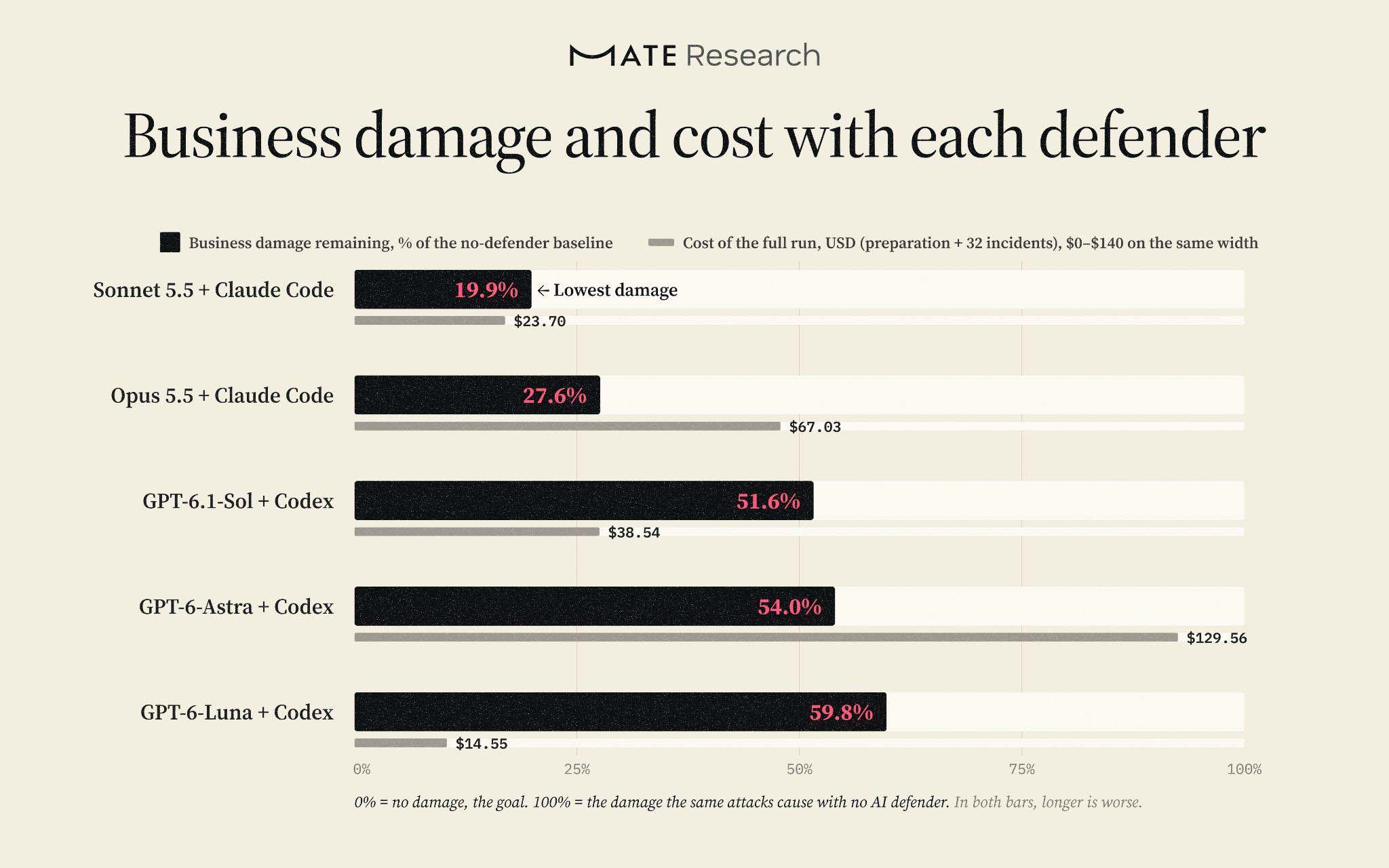
Sonnet prevents the most modeled business damage in this run: 80.1%, leaving 19.9% of baseline damage. At $23.70 total, or $0.74 per incident, it costs less than Opus, Sol and Astra. Cost alone does not explain effectiveness in this run. Luna is the cheapest at $14.55 total, or $0.45 per incident; Astra is the most expensive at $129.56, or $4.05 per incident, with 46.0% observed effectiveness. Luna has the lowest observed effectiveness at 40.2%. These are within-run comparisons, not estimates of production economics.
Sol accesses relevant context and makes the required decision in 81.3% of eligible checks, gets both decisions right in 68.8% of twin pairs (11/16), and passes 26/32 safe missions. These are the highest values on those measures, yet its aggregate effectiveness is 48.4%. Sonnet leads on effectiveness with 43.8% paired judgment (7/16), 22/32 safe missions and six critical incidents, compared with Sol’s five. Opus has the fewest critical incidents, two. Damage-weighted effectiveness, decision accuracy and counts of safe or critical incidents capture different aspects of defense; the raw damage breakdown is needed to explain their divergence.
Traceability remains uniformly low: 0.0% for Luna and Sol, and 3.1% for Sonnet, Opus and Astra, equivalent to one passing evidence package out of 32 for each. The new result is a shared auditability weakness across all five defenders. Zero traceability means no submitted package passed the automated checks; it does not mean no evidence was collected or produced.
5. Future work
Mate will expand generated workflows, align tool behavior more closely with production security products and add attack scenarios as threats evolve. Semantic evidence review, open reference code, human analyst baselines and independent review remain proposed next steps. Because the environment is reproducible, it also supports a standing leaderboard as new models ship, stress tests that add noise and unreliable tools, and cascade routing that sends routine incidents to a cheaper model and escalates when failure is likely. The aim is to learn which capabilities let defenders protect more of the business, respond sooner and operate at a sustainable cost.
References
[1] Maxwell Standen et al. CybORG: A Gym for the Development of Autonomous Cyber Agents. 2021. https://arxiv.org/abs/2108.09118
[2] Mitchell Kiely et al. Exploring the Efficacy of Multi-Agent Reinforcement Learning for Autonomous Cyber Defence: A CAGE Challenge 4 Perspective. AAAI 39(28), 28907-28913, 2025. Official specification: https://github.com/cage-challenge/cage-challenge-4
[3] Yiran Wu et al. ExCyTIn-Bench: Evaluating LLM agents on Cyber Threat Investigation. Version 3, 2026; initial preprint 2025. https://arxiv.org/abs/2507.14201v3
[4] DeepTempo. SOCBench: An Open Harness and Benchmark for AI in Cybersecurity Operations. Repository, accessed 30 September 2026. https://github.com/DeepTempo/socbench
[5] Lehan Wang et al. SecRespond: Benchmarking AI Agents for Real-World Post-Compromise Incident Response. Version 1, 2026. https://arxiv.org/abs/2607.26791v1
[6] Paul Kassianik, Blaine Nelson and Yaron Singer. Beyond Success Rate: Cost-Aware Evaluation of Offensive and Defensive Security Agents. Version 3, 2026. https://arxiv.org/abs/2607.15263v3
[7] Chiyu Zhang, Marc-Alexandre Côté, Michael Albada, Anush Sankaran, Jack W. Stokes, Tong Wang, Amir Abdi, William Blum and Muhammad Abdul-Mageed. DefenderBench: A Toolkit for Evaluating Language Agents in Cybersecurity Environments. Version 4, 2025. https://arxiv.org/abs/2506.00739
[8] Gal Engelberg, Michael Arenzon and Leon Goldberg. Open Security Benchmark: Towards Autonomous Enterprise Cyber Defense. Version 1, 2026. https://arxiv.org/abs/2607.27288v1
[9] Daniel Begimher, Cristian Leo, Jack Huang, Pat Gaw and Bonan Zheng. SIR-Bench: Evaluating Investigation Depth in Security Incident Response Agents. Version 1, 2026. https://arxiv.org/abs/2604.12040v1