Agentic response you can trust at machine speed.
It’s hard to trust AI to take action on alerts. Mate checks every action against your environment before it runs, so you can finally trust AI to respond.
Get a demo

Security Response Solution of the Year
Response is the hardest thing in security to automate, because a wrong action can hurt the business more than the attack. That's the part we were recognized for.
Security teams don't trust AI to act
There are two ways to get response wrong. Act too slowly, and the attacker does the damage. Act on the wrong thing, and the response does the damage. Today every action waits for a human, while the attacker keeps moving.
Manual response doesn't scale
Response takes days, and the outcome depends on which analyst picks it up.
Playbooks break
Hardcoded workflows break when a tool or the attack changes. The decision still lands on a human.
Point actions are blunt
Native actions live inside one tool. No view of what else breaks, so the default is to isolate the whole host or disable the entire account.
Triage stops at the verdict
AI tells you what happened, then hands the action back to your team.
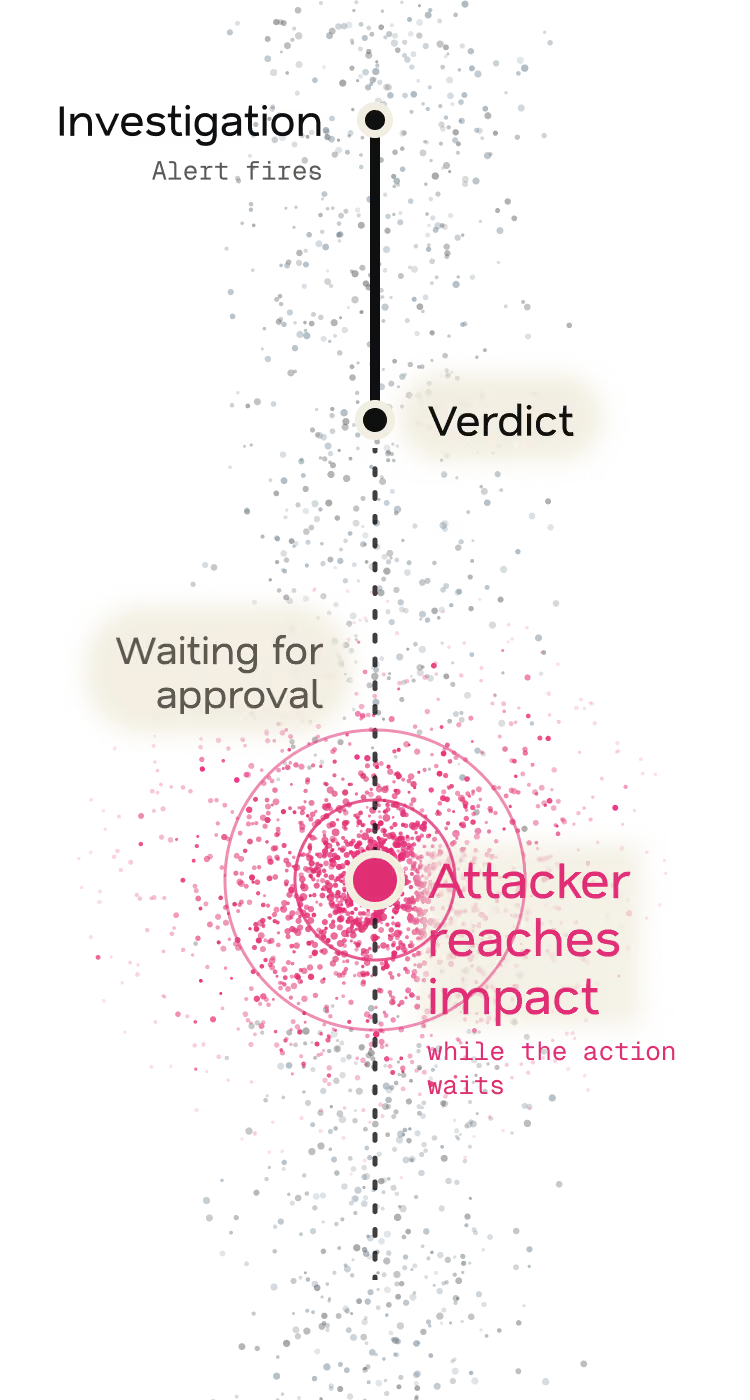
Attackers hit while AI waits for approval to act.




Investigation
Alert fires
Verdict
Waiting for approval
Attacker reaches impact
while the action waits




Investigation
Alert fires
Verdict
Waiting for
approval
Attacker
reaches
impact
while the action
waits
AI without context cannot act safely, because it does not know what the action will break
Safe response
runs on context
Mate maps your environment: who owns what, what's critical, and what depends on it. So it knows what is the right action to take right now, and what an action might break.
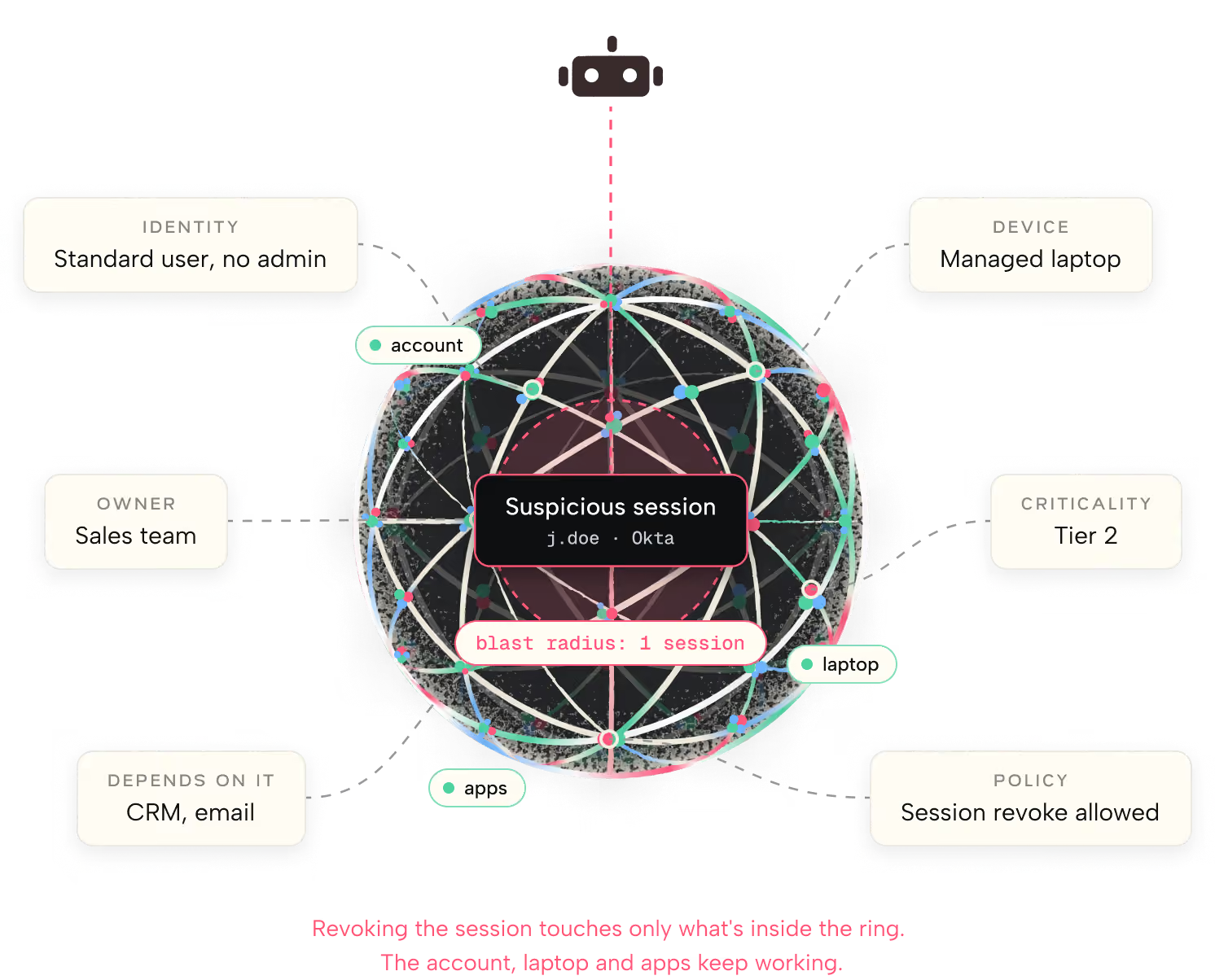
Mate stops the attack everywhere and closes the way in
Threat confirmed. Response initiated

Act
Runs your set actions in every integrated tool, automatically or after review, depending on your policy.

Hunt
Searches your whole environment for the same threat and adds new detections.

Prevent
Finds the control that could have stopped it and recommends the fix.


Incident closed
When it’s your own user or device, Mate first checks who owns it and what depends on it, then contains it and hands off recovery if data was lost.
CPR: three questions before Mate takes action
Before touching production, a senior responder asks: How sure am I? How narrow can I make this? Can I undo it? Mate asks this about every action. If there's a precise action that stops the threat, Mate takes it. If there isn't, your analysts get the action with its CPR score, so they can decide fast.

How sure is the call?
Based on organizational context, and Mate's proven track record on similar cases, not self-reported by the model.

What might break?
Mate weighs what else might be damaged during response, before it acts.

Can it be undone?
Mate knows what it can roll back, and sets a higher bar for what it can't.
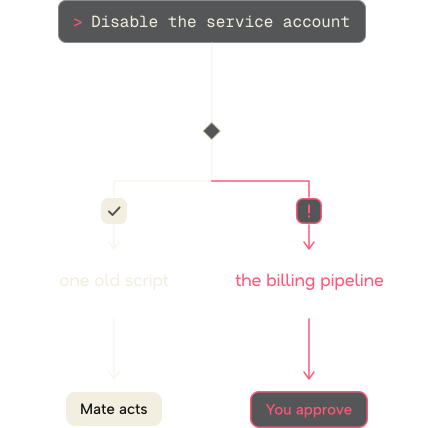
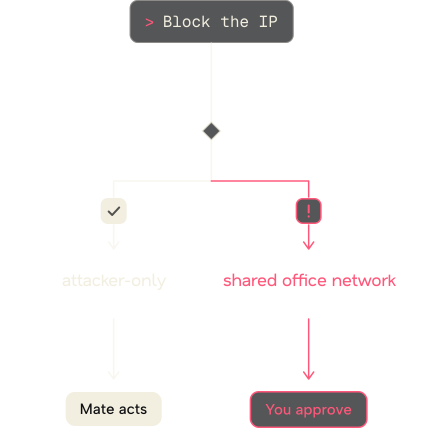
Same threat, two actions, two decisions
Precision determines actions
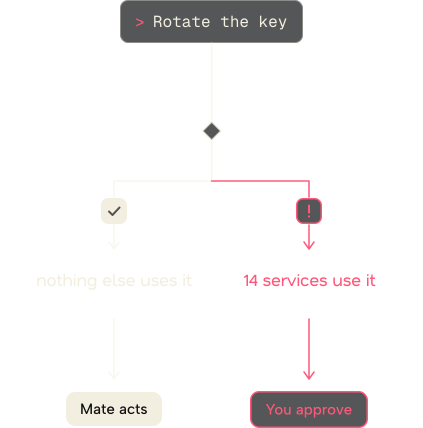
An action can be precise on one asset and blunt on another.
Before Mate acts, it checks what depends on this asset in your environment right now.
Response that holds up when your stack changes, and when the attacker does.
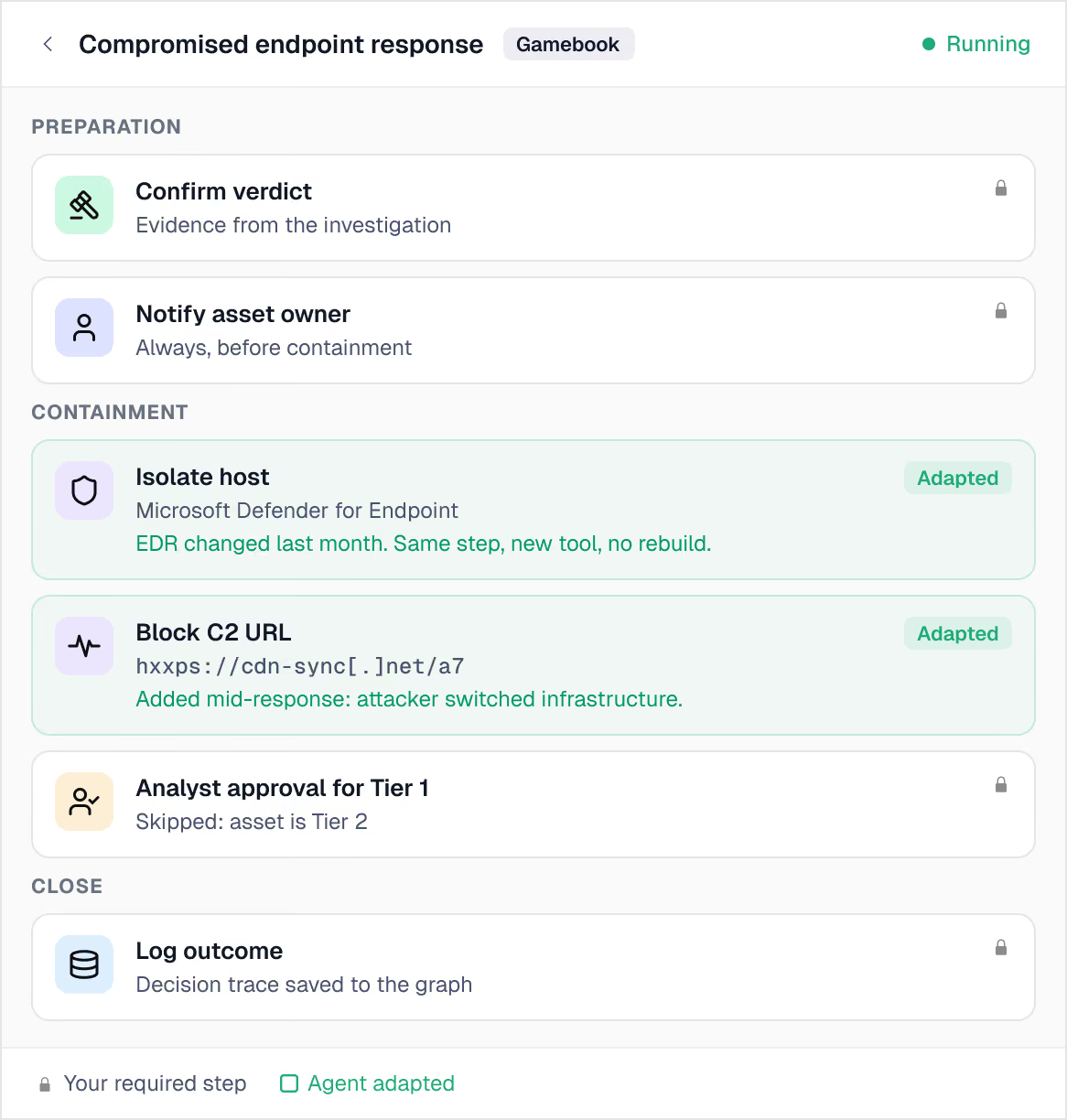
Gamebooks give Mate's agents a direction to follow: your non-negotiable steps, your processes, your approvals. Inside that direction, agents use discretion. You swap your EDR, migrate your SIEM, or face a tactic the plan didn't anticipate, and the response adapts instead of breaking.

You set the steps that always run
You define the steps that always happen. Agents adapt everything around them, with full visibility.

Tool-agnostic
Survives SIEM migrations and EDR swaps without a rebuild.

autonomy on your terms
Start with an analyst approving every action. Expand autonomy tier by tier as Mate proves itself on your cases. Your asset tiers and policies decide what runs on its own and what waits for a human.

Policy-based
gating
Asset criticality and policy decide autonomous vs. analyst-in-the-loop.

Validated action
classes only
Autonomy is limited to action types Mate has proven on your environment.

A second opinion on high-impact actions
A separate judge agent validates the action before it runs.

Decision trace on everything
Every action carries the evidence, the CPR scores, and the policy that allowed it.
Accurate decisions,
safe actions, in minutes
Mate knows who owns the device, how critical it is, and what depends on it.
So it only acts when the action is low-risk, and can be undone.




Knowing when to act, and when to hold back
Every action is weighed for risk and reversibility. Mate acts on the safe ones and holds back on the rest.

“Mate goes beyond processing alerts - it continuously learns how our environment operates. It becomes more attuned to what matters most, helping our team focus on the work that truly strengthens our security posture.”

Chief Information Security
Officer, Bridgewater Associates