



- Agentic SOC investigates alerts using evidence and adapts actions based on organizational context, with humans approving high-impact decisions.
- Organizational context is essential for accurate investigations, false positive reduction, and effective response.
- Adaptive investigations outperform static playbooks by following evidence instead of predefined workflows.
- Success is measured through metrics like MTTD, MTTR, alert escalation rate, and investigation agreement rate.
- Mate delivers context-grounded investigations using its Security Context Graph, continuous detection and response, and human-supervised actions.
What Is an Agentic SOC?
An agentic SOC is a security operations model in which AI agents run automated, contextual investigations into incoming alerts, recommending or executing the appropriate action based on their findings. This differs from traditional SOCs and SOAR-driven operations, where analysts or static playbooks perform most of the investigative work and automation is limited to scenarios anticipated in advance. A positive result looks like alerts being closed with evidence, not assumptions, response times shrinking from hours to minutes, and analysts spending their time on decisions that require human judgment rather than manually collecting context.
Why Organizations Are Moving to Agentic SOC
Security leaders are rethinking how their SOCs operate, not because of a single technology gap, but because the demands placed on security operations have fundamentally changed. The shift toward an agentic SOC is driven by 4 converging forces:
- Rising Alert Volumes Outpacing Analyst Capacity: Modern environments generate more security telemetry every year, and manual alert triage consumes more analyst hours than teams can add without either cutting corners or falling behind.
- Security Talent Shortages and Burnout: Analysts spend too much time gathering context for alerts that turn out to be false positives, leaving less time for high-priority investigations and increasing the risk of burnout.
- Faster Response Expectations Across the Business: Executives, customers, and regulators increasingly expect security incidents to be investigated and contained in minutes rather than hours, putting pressure on SOC teams to respond faster without sacrificing accuracy.
- Increasing Attack Complexity Requiring Deeper Investigation: Modern attacks often span identities, endpoints, cloud environments, email, and SaaS applications, making manual investigations slower and more difficult as analysts connect evidence across multiple systems. Attackers are compounding this problem too, as software vulnerabilities have overtaken stolen credentials as the leading way in, now accounting for 31% of breaches.
How Agentic SOC Differs From Traditional SOAR and Automation
SOAR and traditional automation solved an important problem: turning repetitive analyst tasks into repeatable workflows. The difference with an agentic SOC isn't whether automation exists; it's how the system decides what to do once an alert enters the SOC.
The shift from traditional automation to an agentic SOC is less about replacing playbooks and more about changing their role. Instead of dictating every step of an investigation, automation provides the foundation while AI agents determine the next best action based on the evidence, organizational context, and the evolving state of the investigation.
Core Components of an Agentic SOC
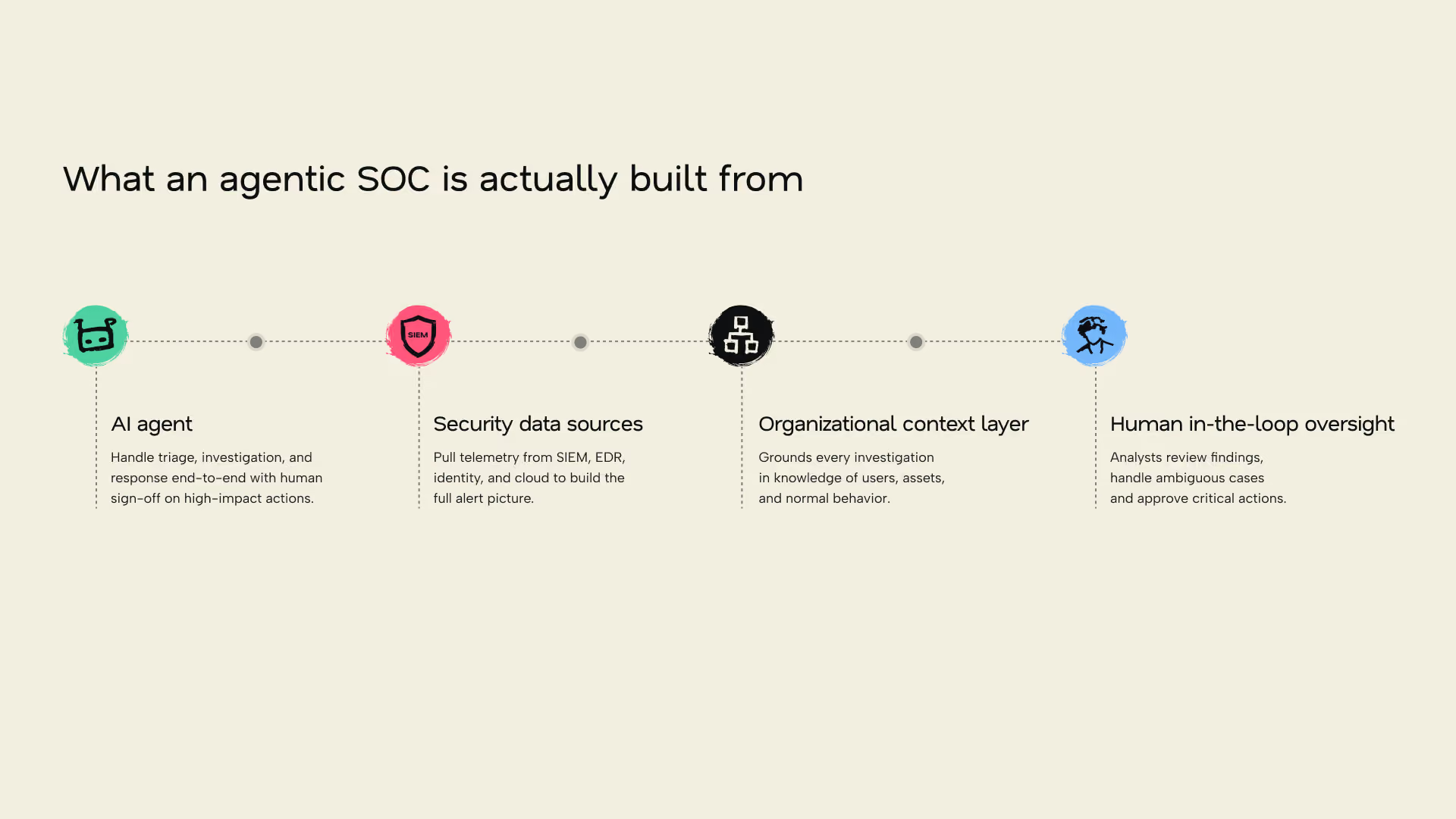
An agentic SOC is built from a small set of components that work together, not in isolation. Each one plays a distinct role in how alerts get investigated and resolved.
- AI Agents for Triage, Investigation, and Response: Agents handle the investigative workload end to end, gathering evidence, reasoning through it, and recommending or taking action, while final authority on high-impact response decisions stays with human analysts.
- Security Data Sources and Integration Depth: Agents pull telemetry from across the stack, including SIEM, EDR, identity providers, and cloud platforms, and the depth of that integration determines how much of an alert's full picture an agent can see.
- Organizational Context Layer: This is the foundation the other components depend on. Without an understanding of the organization's users, assets, and normal behavior, an agent's investigations are only as good as the raw data in front of it.
- Human-in-the-Loop Oversight and Approval: Analysts review agent-led investigations, step in on ambiguous cases, and approve high-impact actions, keeping decision authority with the people accountable for the outcome.
Key Metrics to Measure Agentic SOC Performance
Not every improvement an agentic SOC delivers is easy to see day to day, which is why tracking the right metrics matters, especially with the global average cost of a data breach at $4.44 million. These 4 give the clearest picture of whether agents are improving outcomes.
Common Use Cases for Agentic SOC
An agentic SOC doesn't apply to a single function within security operations. It changes how the team approaches several different workflows at once.
Alert Triage and False Positive Reduction
Most SOCs lose analyst hours to alerts that turn out to be non-threats, and traditional triage forces a choice between speed and thoroughness. An agentic approach removes that trade-off by investigating every alert against organizational context rather than sampling based on severity or volume. False positives get closed with a documented rationale instead of being suppressed or bulk-dismissed, which means the alert was reviewed, not just hidden. This shifts analyst time toward the alerts that most warrant a second look.
Context-Driven Threat Investigation
Once an alert is flagged, the investigation itself is where an agentic approach diverges most from scripted automation. Instead of following a fixed set of steps, agents pull evidence from across the environment and adjust the investigation path as new findings emerge, similar to how an experienced analyst would follow a lead. This produces a complete evidence trail rather than a partial one built around whatever the playbook anticipated. Analysts inherit a finished investigation to evaluate, not a raw alert to start working from scratch.
Incident Response With Human Oversight
Investigation and response are not the same decision, and an agentic SOC keeps that boundary intact. Agents can recommend or stage a response action, but execution of high-impact steps, such as isolating a system or disabling an account, stays with a human analyst who approves it. This preserves accountability for consequential actions while still removing the manual work of gathering the evidence that the decision depends on. The result is a faster response without removing the judgment call from the person responsible for it.
Continuous Threat Hunting
Threat hunting has traditionally depended on an analyst having the time to proactively investigate the environment without a specific alert prompting it, which rarely happens consistently. An agentic SOC treats hunting as an ongoing function rather than a periodic project, continuously evaluating activity against organizational context to surface patterns that wouldn't trigger a standard alert on their own. This keeps low-and-slow activity from sitting unnoticed simply because no single event crossed a threshold. Over time, it also surfaces where existing detection coverage has gaps.
Challenges of Adopting an Agentic SOC
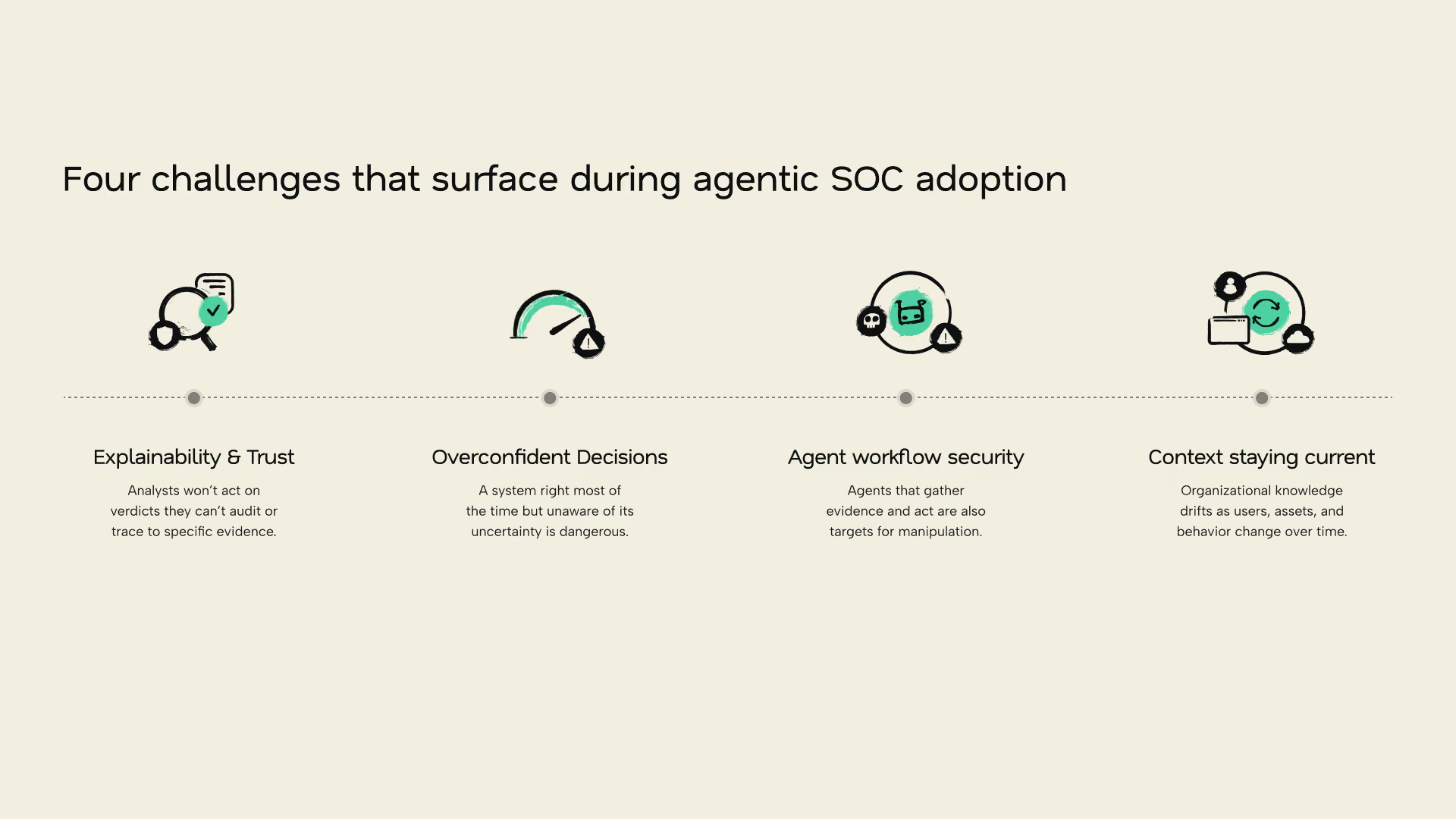
Moving to an agentic model surfaces new questions that traditional SOC tooling never had to answer. The challenges below show up most often during adoption.
- Maintaining Explainability and Analyst Trust: Analysts won't act on a verdict they can't audit, and a rationale that can't be traced tends to get double-checked anyway, which quietly erodes the speed advantage the system was supposed to deliver. Every investigation needs to show which evidence supported the conclusion and why competing explanations were ruled out, not just the final call.
- Preventing Overconfident Autonomous Decisions: Confidence and accuracy aren't the same thing, and a system that's right most of the time but doesn't know when it's uncertain is dangerous precisely because it looks reliable either way. Ambiguous cases need to route to a human instead of getting resolved with false certainty.
- Securing Agent Workflows Against Manipulation: An agent that gathers evidence and takes action is also a new target, not just a new capability, whether that's manipulated telemetry steering an investigation or inputs crafted to trigger an unwarranted action. Securing this layer means auditing what an agent was shown as closely as what it decided.
- Keeping Organizational Context Current: An agent's investigation is only as accurate as the context it's reasoning against, and that context has a shelf life as users, assets, and normal behavior change. Keeping it current is an ongoing operational responsibility, closer to tuning detection rules than installing a tool once and walking away.
Best Practices for Implementing an Agentic SOC
Getting an agentic SOC right depends less on the technology itself and more on how it's implemented. The following practices separate deployments that deliver value from ones that stall.
How Mate Delivers Accurate, Context-Grounded Investigations at Scale
Mate applies the agentic SOC model described throughout this article with a specific architecture built around organizational context as the foundation everything else depends on. The platform's investigations, response actions, and onboarding process are all designed around that same principle: context first, action second.
- Automated, Contextual Investigations on Every Alert: Mate investigates every alert in the queue, including informational ones typically left uninvestigated, closing out false positives instead of routing them past review unexamined.
- Security Context Graph Closes False Positives Before Analyst Review: The Security Context Graph restructures data around the context an analyst would naturally apply, so false positives are closed through investigation rather than suppressed by a rule.
- Continuous Detection and Continuous Response (CD/CR): Mate's closed-loop framework treats every closed investigation as a compression point that feeds back into detection logic. SOPs act as gateways into adaptive investigations rather than fixed scripts, allowing the system to get sharper with every alert it closes.
- Supervised Response With Human Approval on High-Impact Actions: Response actions execute in line with existing SOPs, with a human in the loop, keeping analysts focused on the decisions that require judgment rather than on the manual work behind them.
- Security Context Graph Built Within 24 Hours of Integration: Mate onboards within 24 hours and reaches investigation-ready results in that window, rather than the months of manual training and tuning legacy tools typically require.
- Detection Building From Closed Investigations: Mate transforms closed investigations into production-ready detections, feeding each resolved case back into the system so future alerts of the same pattern are caught automatically instead of requiring a fresh investigation every time.
Conclusion
A decade of adding tools hasn't fixed the SOC's real problem because alerts multiply faster than anyone can investigate them properly. Agentic systems close that gap by investigating first and making decisions based on evidence instead of guesswork. The organizations seeing real gains aren't the ones automating the most. They're the ones grounding every agent decision in an organizational context, keeping humans involved in decisions that require judgment, and treating adoption as an ongoing discipline rather than a one-time rollout.
That's the principle Mate is built on: a Security Context Graph that gives every investigation the same institutional memory a senior analyst would bring, feeding a CD/CR loop that gets sharper with each alert it closes. As attacks continue to outpace manual triage, the SOCs that pull ahead won't be the ones with the most automation. They'll be the ones whose agents know the organization they're defending well.
FAQs
An agentic SOC investigates every alert against organizational context before deciding whether it's benign, allowing false positives to be closed with documented evidence instead of being suppressed.
- Review the alert alongside identity, endpoint, cloud, and asset context.
- Validate whether the observed activity matches expected organizational behavior.
- Close verified false positives with supporting evidence instead of suppression rules.
- Escalate only alerts that require human judgment.
Find out how to make false positives an asset.
The strongest indicators are improvements in MTTD, MTTR, alert escalation rate, and investigation agreement rate between AI agents and analysts.
- Measure detection and response times before and after deployment.
- Track how many alerts agents resolve without analyst intervention.
- Compare agent conclusions with independent analyst reviews.
- Continuously tune workflows using investigation outcomes.
Even capable AI agents can only produce reliable investigations when they understand the organization's users, assets, identities, and normal operating behavior.
- Continuously synchronize identity, asset, endpoint, and cloud telemetry.
- Build behavioral baselines across the environment.
- Ground every investigation in current organizational context.
- Refresh context as infrastructure and users change.
Mate takes alerts as input, enriches them with its Security Context Graph, performs contextual investigations, and outputs evidence-backed conclusions that analysts review only when needed.
- Connect security telemetry to build organizational context.
- Automatically investigate every incoming alert, including informational alerts.
- Close benign alerts with documented evidence.
- Route only meaningful investigations for analyst approval.
Explore Mate’s security context graph.
Mate feeds completed investigations back into its Continuous Detection and Continuous Response workflow so future alerts of the same pattern can be detected automatically.
- Complete an evidence-backed investigation.
- Convert validated findings into production-ready detections.
- Feed new detections into ongoing monitoring.
- Strengthen future investigations through continuous feedback.
Learn how AI is empowering (not replacing) SOC teams.