


“AI threat detection” has become one of the most crowded labels in security, and one of the least precise. The same three words now cover tools that do fundamentally different jobs. An endpoint agent signals suspicious process activity. A SIEM aggregates logs across the environment. A platform investigates an alert end-to-end and returns a verdict.
Lumping them together is exactly why the category resists evaluation, because two products marketed identically may solve almost none of the same problems. The pressure is real. Verizon's 2026 Data Breach Investigations Report found that exploitation of vulnerabilities has become the leading initial access vector, climbing from 20% to 31% of breaches, a 55% rise, while AI is accelerating how quickly attackers operationalize known techniques rather than introducing entirely new attack surfaces. At that speed, the tools that matter are the ones that close the gap between detecting a threat and deciding what to do about it.
Top AI Threat Detection Tools at a Glance: TL;DR
Each tool below earns its place by doing a specific job well, not by topping a generic ranking. The table maps each one to what it's built for, so you can find the closest fit to your environment before reading the full entries.
6 Best AI Threat Detection Tools for Enterprise SOC Teams
These six tools do not compete on a single leaderboard, because an EDR, an NDR, a SIEM, and an AI SOC analyst solve different parts of the same problem. The list below groups them by the job each does, so the question becomes which one fills the gap in your stack, not which ranks highest.
1. Mate Security
Mate Security is a Continuous Detection, Continuous Response platform running triage, investigation, response, and detection tuning grounded in organizational context. The platform builds a Security Context Graph, a living organizational brain modeling your users, assets, and behavior.
The platform understands your SOPs as gateways and adapts dynamically according to current context, then provides analysts with a verdict and confidence level, with full reasoning transparency, delivering supervised response with a human in the loop and keeping analysts focused on the decisions that demand human judgment. Mate is operational in less than 24 hours with precise verdicts, unlike most solutions that require weeks of learning and tuning before they're operational.
Key strengths: Closes up to 85% of false positives by investigating against the Security Context Graph, not by suppressing rules, on an open, extensible, and configurable platform that avoids vendor lock-in.
Best fit: SOC teams spending analyst hours confirming alerts that turn out to be benign.
Worth noting: Mate is a Continuous Detection, Continuous Response platform that can work alongside your existing detection stack.
2. Vectra AI
Vectra AI detects attacker behavior across network, identity, and cloud. Its Attack Signal Intelligence is trained to recognize real attacker tactics mapped to MITRE ATT&CK, so analysts see prioritized threats rather than raw anomaly alerts. The platform deploys agentlessly across hybrid environments and surfaces lateral movement, encrypted command-and-control, and credential abuse that operate at the network and identity layer.
Key strengths: Cuts up to 99% of alert noise by prioritizing attacker behavior over simple deviations.
Best fit: SOCs that need to catch active attackers moving through network and identity.
Worth noting: Vectra adds network and identity coverage alongside EDR, extending visibility beyond the endpoint.
3. Darktrace
Darktrace takes a different path from tools trained on known threats: its Self-Learning AI studies your own environment to understand what normal looks like, then flags the deviations that signal an attack. This makes it effective against novel and AI-driven threats that have no existing signature. The ActiveAI Security Platform spans network, email, cloud, identity, OT, and endpoint, correlating activity across all of them.
When something crosses a risk threshold, the platform can take targeted autonomous action to contain only the offending activity while normal operations continue, and its Cyber AI Analyst investigates alerts to speed up triage.
Key strengths: Self-Learning AI baselines each environment individually, catching unknown threats without relying on predefined rules.
Best fit: Organizations that prioritize catching novel and AI-generated threats over cataloged ones.
Worth noting: The behavioral model requires a learning period to establish baselines before detection reaches full accuracy.
4. CrowdStrike Falcon
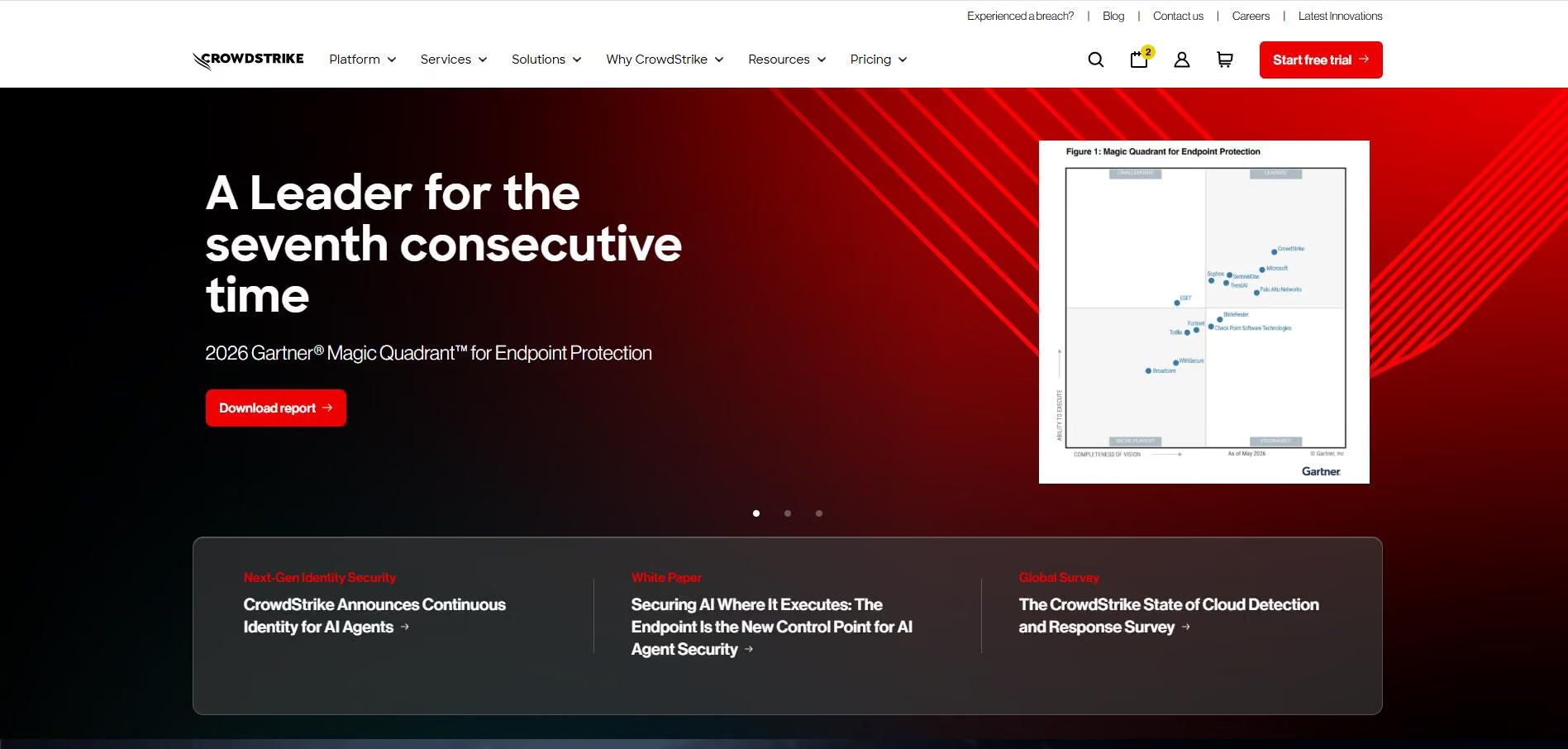
CrowdStrike Falcon is an AI-native platform built on the endpoint, using real-time indicators of attack and enriched telemetry to catch ransomware, lateral movement, and stealthy intrusions. A single lightweight sensor deploys in minutes and extends visibility from the endpoint out to identity, cloud, and SaaS.
Its Charlotte AI applies generative and agentic AI to triage detections, investigate incidents, and automate response, compressing work that once took hours into minutes. The platform pairs this with elite threat hunting through its managed services, surfacing sophisticated activity that automated detection alone might miss.
Key strengths: Real-time indicators of attack and AI-driven triage deliver high-fidelity detections with minimal false positives across endpoint, identity, and cloud.
Best fit: Enterprises building their security program around endpoint protection at scale.
Worth noting: Falcon's depth is anchored in the endpoint, so full cross-domain coverage means adopting additional platform modules.
5. Microsoft Sentinel
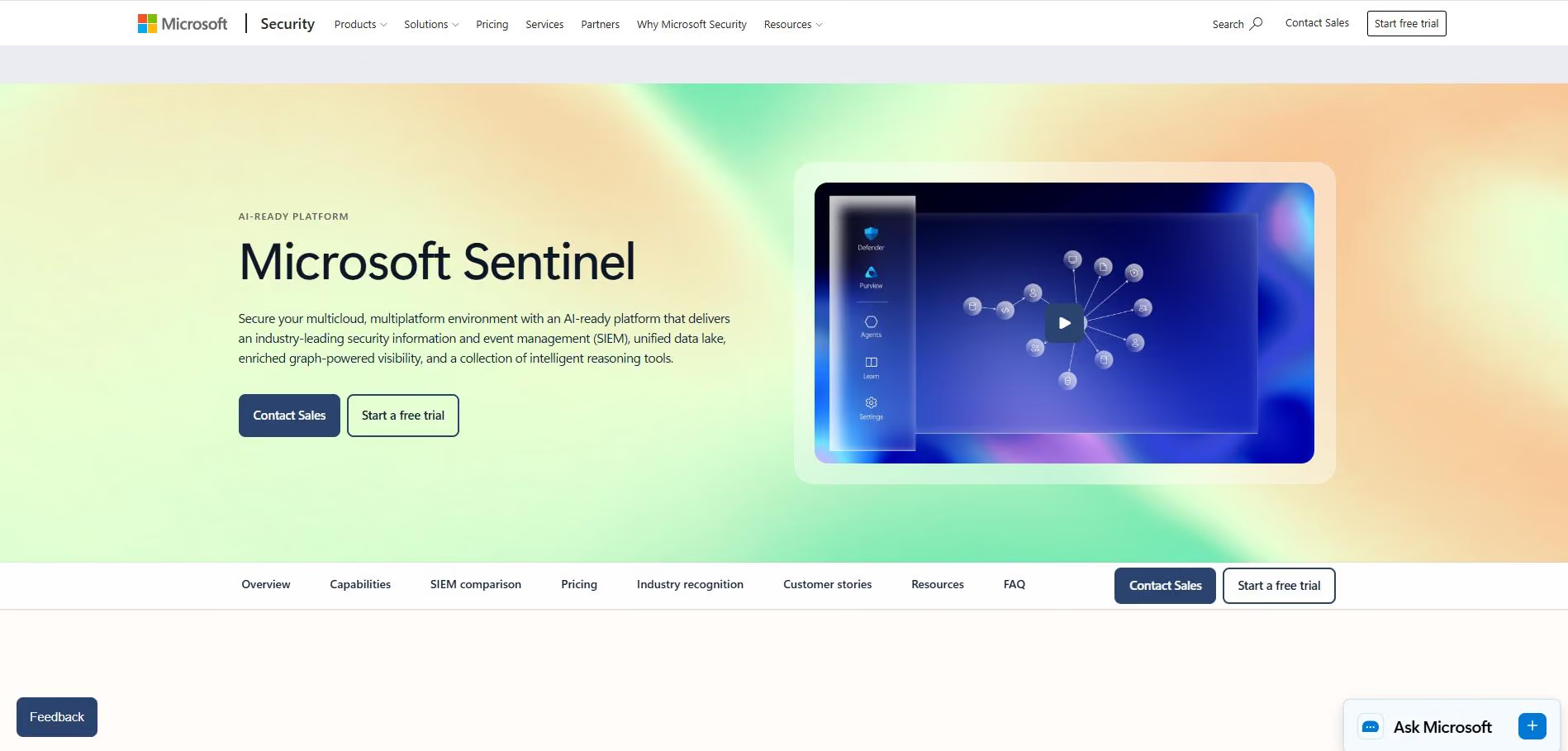
Microsoft Sentinel is a cloud-native SIEM that has grown into an AI-ready platform, unifying log analytics, SOAR, UEBA, and threat intelligence in one place. It pulls telemetry from across multicloud environments, then layers AI-driven detection and investigation on top.
A unified data lake and security graph give analysts cross-estate context, while Security Copilot summarizes incidents, writes queries, and recommends next steps. More than 400 connectors ingest Microsoft and third-party data, with the tightest integration across Defender and Entra.
Key strengths: Consolidates SIEM, SOAR, UEBA, and a security data lake on one cloud-native platform, with agentic Copilot reasoning over the data.
Best fit: SOCs standardizing on Microsoft and wanting telemetry, detection, and response on a single platform.
Worth noting: Consumption-based pricing means costs scale with data ingested, so high-volume environments need to manage ingestion deliberately.
6. Securonix
Securonix is a cloud-native SIEM built on user and entity behavior analytics, designed to catch insider threats, credential abuse, and lateral movement. It baselines normal behavior for users and entities, then flags the deviations that signal risk across hybrid and cloud environments.
An Agentic Mesh of specialized AI agents now sits over its Unified Defense SIEM, coordinating detection, investigation, and response under human oversight. Sam, its AI SOC analyst, handles triage, enrichment, and investigation summaries. Six straight years as a Gartner SIEM Leader speak to its enterprise track record.
Key strengths: Deep UEBA surfaces insider threats and credential abuse through behavioral baselining, with agentic AI improving response times by up to 60%.
Best fit: Enterprises prioritizing insider-risk detection and behavior-based analytics at scale.
Worth noting: Securonix is a large-scale enterprise platform, so smaller teams may find deployment and tuning more involved.
AI Threat Detection Tools Comparison Overview
This table is built for side-by-side scanning. It adds deployment models and reduces each tool to its core differentiator, so you can compare across the row rather than re-read the full write-ups.
Why Traditional Threat Detection Approaches Are Breaking Down
The tools most SOCs rely on were assembled over years of adding new point products onto existing ones. That layered architecture is now under three pressures at once: cost, the speed at which context goes stale, and the volume of investigation that machine-speed attacks demand.
- SIEM Costs and Data Sprawl Across Lakes and Point Solutions: Every new data source, lake, and niche tool adds ingestion cost and another silo, so visibility fragments at exactly the moment teams need it unified. The result is a stack that grows more expensive to feed while delivering a more scattered picture of what is actually happening.
- Manual Detection Engineering Decaying Faster Than Context Changes: Detection rules are written against a snapshot of the environment, but environments shift constantly as identities, assets, and ownership change. A rule that was accurate when written quietly drifts out of date, and the manual effort to keep rules current cannot match the pace at which the context underneath them moves.
- Investigations Struggling to Keep Pace With Machine-Speed Attack Volumes: When attacks compress from months to hours, the bottleneck moves from detecting a signal to investigating it fast enough to matter. Human-paced investigation, pulling context from scattered systems to turn an alert into a verdict, strains to keep up once attackers operate at machine speed.
Common Use Cases for AI Threat Detection Tools
AI threat detection earns its place across several recurring problems, each where speed, scale, or behavioral nuance defeats manual methods. These are the situations where SOC teams most often put these tools to work.
- Detecting Insider Threats: Behavioral baselines flag when a legitimate user starts acting abnormally, accessing unusual data, moving laterally, or exfiltrating at odd hours, even though the credentials are valid.
- Preventing Ransomware Attacks: AI catches the precursors- mass file encryption, lateral movement, and privilege escalation- early enough to contain an attack before it spreads across the environment.
- Identifying Advanced Persistent Threats (APTs): By correlating faint signals across long timeframes, AI surfaces the slow, stealthy campaigns that stay below the threshold of any single alert.
- Securing Cloud Environments: AI monitors API calls, configuration drift, and cross-account access across AWS, Azure, and GCP, catching anomalies in dynamic, ephemeral workloads that static rules miss.
- Protecting APIs and Web Applications: Behavioral analysis spots API abuse, credential stuffing, and automated bot activity that blend into normal traffic patterns.
- Monitoring Remote Workforce Activity: AI evaluates login behavior, device context, and access patterns to flag account compromise and impossible-travel scenarios across a distributed workforce.
Essential Features to Look for in AI Threat Detection Tools
The right tool depends on your environment, but a handful of capabilities distinguish platforms that improve detection accuracy from those that simply generate more alerts. The table below explains what each feature means and why it matters.
How to Choose the Right AI Threat Detection Tool for Your SOC
No single tool wins for every team, so the right choice comes down to how well a platform fits your environment, your stack, and the way your analysts already work. These five questions cut through vendor messaging to what actually separates the options.
- Assess How Each Tool Builds and Maintains Organizational Context: Ask whether the tool learns your environment once and keeps that knowledge current, or rebuilds context from scratch on every investigation. A platform that retains and updates organizational context delivers more accurate verdicts and holds onto institutional knowledge when analysts leave.
- Evaluate Time to Value Against Manual Tuning Requirements: Some tools deliver useful results within days, while others need months of rule writing and tuning before they earn their keep. Press vendors on what the platform actually does on day one versus what it does only after a long configuration period.
- Confirm Human-in-the-Loop Controls for Response Actions: Verify that the tool automates routine containment but routes high-impact actions through human approval. Full autonomy on consequential decisions is a risk, and the right balance keeps analysts in control of the actions that matter most.
- Check Integration Depth Across Your Existing Security Stack: A tool is only as useful as the data it can reach, so confirm it connects cleanly with your SIEM, EDR, identity, and ticketing systems. Shallow or one-way integrations create blind spots and force the manual data-gathering that the tool was meant to eliminate.
- Consider How Investigation Quality Is Measured and Benchmarked: Look past detection counts to whether the vendor can show how investigation accuracy is measured, with named customer outcomes rather than demo-stage promises. Quality you can benchmark is quality you can trust in production.
Conclusion
There is no single best AI threat detection tool, and any list that promises one is selling a ranking, not an answer. Endpoint, network, SIEM, and AI SOC analyst tools each solve a different slice of the problem, which means the right pick depends entirely on which slice is currently hurting you.
So begin with your own gaps, not someone else's leaderboard. Find where your stack goes quiet, where alerts pile up uninvestigated, or context goes missing, and choose the tool built to fill that specific silence. Fit beats fame every time.
FAQs
AI threat detection tools analyze security signals using machine learning and contextual reasoning to identify, investigate, and prioritize threats faster than static rule-based systems.
- Collect telemetry from endpoints, identities, cloud services, and network infrastructure.
- Correlate evidence to distinguish malicious activity from normal behavior.
- Produce prioritized investigations or verdicts that help analysts decide on the next action.
- Use investigation outcomes to continuously improve future detection accuracy.
No. Most AI threat detection platforms complement SIEMs and EDRs by improving investigation, prioritization, or response rather than replacing existing detection tools.
- Keep your existing SIEM and EDR as telemetry sources.
- Add AI-powered investigation to automate evidence collection and analysis.
- Use contextual verdicts to reduce manual analyst effort.
- Reserve analyst attention for high-impact incidents.
Explore the limitations of autonomous SOCs.
The strongest platforms investigate alerts using organizational context instead of suppressing detection rules, allowing analysts to separate benign activity from genuine attacks.
- Ingest alerts from existing security tools.
- Enrich each alert with identity, asset, behavioral, and historical context.
- Validate evidence against organizational relationships and workflows.
- Return a documented verdict with supporting reasoning instead of simply dismissing the alert.
Mate Security combines your security telemetry with its Security Context Graph to investigate alerts through adaptive workflows and deliver investigation-ready verdicts.
- Input alerts from your existing detection stack.
- Enrich every investigation with organizational relationships stored in the Security Context Graph.
- Leverage existing playbooks and adapt dynamically according to current context.
- Output a documented verdict with recommended response actions, auto-executed for routine cases and routed for analyst approval on high-impact or critical-asset actions.
Learn more about Mate’s Security Context Graph.