

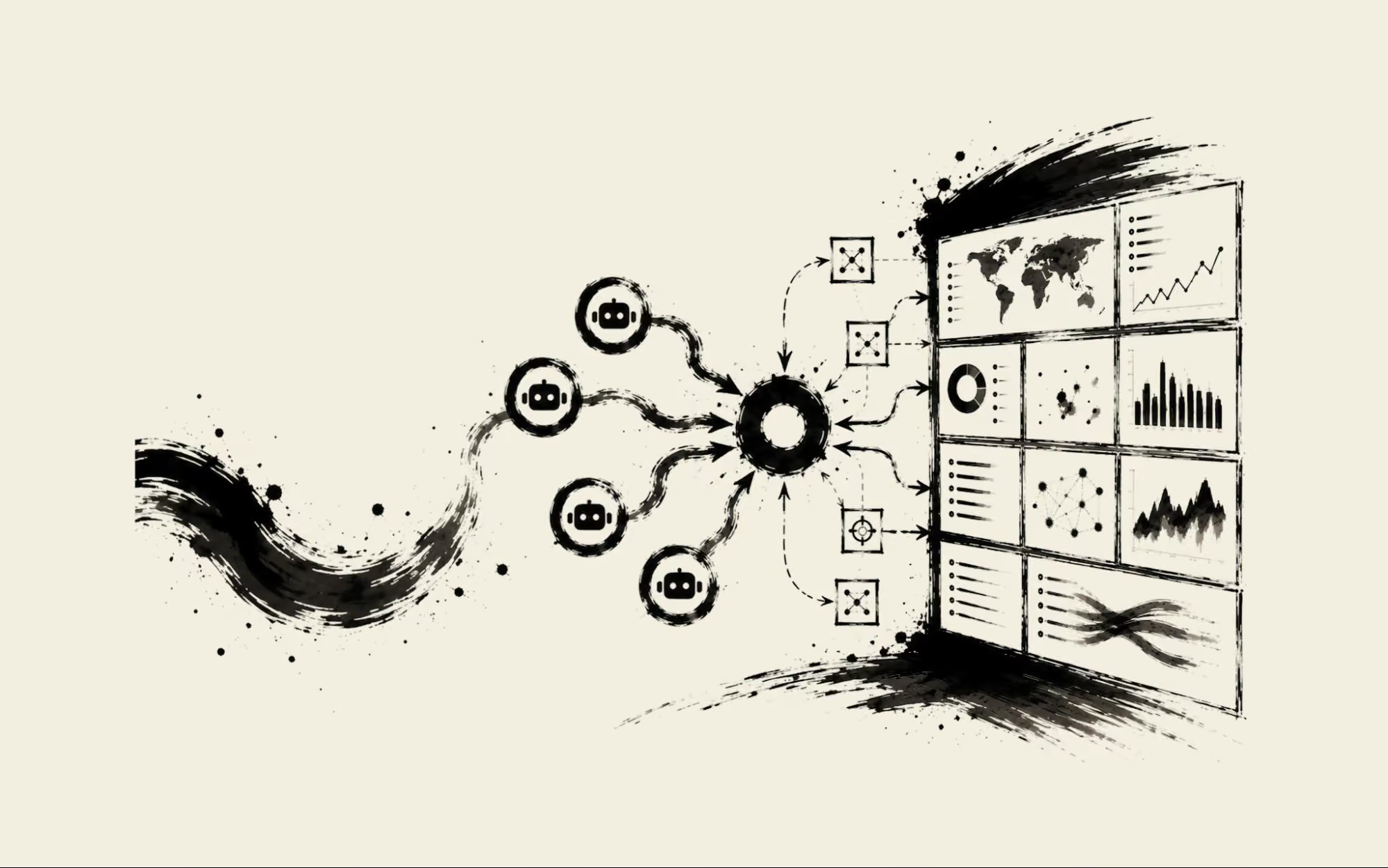

- AI SOC automation combines AI to automate alert triage, detection, investigations, threat correlation, and response actions.
- Most AI SOC platforms fail because they lack organizational context, leading to unreliable verdicts and increased false positives.
- Effective AI SOC automation uses contextual reasoning, telemetry correlation, and human oversight to improve detection and response workflows.
- Best practices include focusing on high-impact use cases, grounding automation in a business context, and continuously refining detection logic with investigation outcomes.
What Is AI SOC Automation?
AI SOC automation is the use of artificial intelligence and agentic AI systems to automate Security Operations Center (SOC) tasks that analysts have traditionally performed manually, including alert triage, incident investigation, threat correlation, and response execution. These systems apply reasoning and contextual analysis across security telemetry from SIEM, EDR, XDR, identity providers, cloud platforms, and ticketing systems to generate verdicts, enrich investigations, and execute response actions at machine speed. Human oversight remains essential for high-impact decisions and complex incident handling.
Why Context Is What Most AI SOC Automation Products Get Wrong
Most AI SOC platforms fail at the same point: they attempt to generate context in real time during the investigation rather than building it as an architectural capability, and they do not use the same context layer across investigation, response, detection, and hunting. The AI can summarize an alert, but not determine whether the activity is normal for the organization.
Human analysts bridge that gap instinctively. They know emails from training@acme.com are simulated phishing because a Slack thread flagged it months earlier, or that a suspicious login from a new geolocation is the CFO traveling for a board meeting because an assistant mentioned it in a ticket. None of that context exists in the SIEM.
It is the equivalent of forcing an analyst to relearn the environment every time an alert fires. AI agents operating this way hallucinate to fill gaps, produce inconsistent verdicts on identical alerts, and generate reasoning that analysts cannot audit or trust.
This is the dividing line between AI SOC automation that scales and automation that stalls in pilots. Without a persistent contextual foundation, automation simply produces unreliable answers faster.
Types of AI SOC Automation
AI SOC automation spans a spectrum of capabilities, from narrow tools that accelerate individual tasks to fully agentic systems that execute end-to-end investigations. Most mature SOCs combine several approaches across the detection and response lifecycle, and the shift toward dynamic, context-aware playbooks is accelerating as static automation reaches its limits.
How AI SOC Automation Works
AI SOC automation operates as a sequential workflow that moves from raw telemetry to executed response. The four stages below describe how a modern AI-driven SOC processes alerts end-to-end.
- Data Collection and Normalization: The system ingests telemetry from across the security stack, including SIEM logs, EDR events, identity signals, cloud platforms, ticketing systems, and internal documentation, normalizing data into a consistent structure so AI agents can reason across sources rather than treat them as silos.
- Threat Detection and Correlation: AI models analyze normalized telemetry to identify suspicious patterns, connect related signals, and surface incidents, adapting to organizational context to uncover threats that static rules often miss.
- Contextual Triage and Decision Support: AI agents evaluate alerts against asset ownership, user behavior, business workflows, and prior investigations, then generate verdicts with supporting reasoning that filter false positives early and prioritize real threats.
- Response Execution With Human Oversight: AI agents execute actions like session revocation, indicator blocking, and ticket closure, while high-impact decisions like endpoint isolation are executed after analyst approval.
AI SOC Automation Architecture and Core Components
Modern AI SOC platforms are built from five interconnected layers, each handling a distinct function in the detection and response lifecycle.
- Data Integration and Ingestion Layer: Connects to the full security stack, including SIEM, EDR, XDR, identity providers, cloud platforms, ticketing systems, and internal documentation, federating data without requiring centralized storage.
- AI and Machine Learning Models: The platform's reasoning engine, where large language models, classifiers, and graph-based systems analyze telemetry, infer intent, and generate evidence-backed verdicts.
- Detection and Correlation Engine: Links related signals across tools and time windows, identifies attack chains, and elevates correlated activity into investigation-ready cases.
- Automation and Orchestration Layer: Executes response actions across the environment, including endpoint isolation, session revocation, IOC blocking, and ticket creation, all governed by SOPs and approval workflows.
- Feedback and Continuous Learning Systems: Captures investigation outcomes and feeds them back into detection logic so every closed case sharpens future detections.
Metrics to Measure AI SOC Automation Success
The right metrics reveal whether AI SOC automation is reducing risk or simply accelerating existing operational problems. The four below are the clearest indicators of real SOC impact:
How AI SOC Automation Fits Into the Existing Security Stack
AI SOC automation does not replace the existing security stack. It operates above it, federating data and coordinating actions across the tools organizations already use.
- SIEM Integration and Alert Aggregation: AI SOC platforms ingest alerts directly from the SIEM and use organizational and external context to ground investigations, while writing confirmed verdicts and new detection rules back into the SIEM to keep its detection logic up to date.
- SOAR and Orchestration Coordination: SOAR platforms provide pre-scripted playbooks for response execution. AI SOC automation provides the reasoning layer that determines which playbooks fit the scenario and when to trigger them, and it can also run dynamic, adaptive response processes beyond what SOAR supports. Organizations already using SOAR can integrate both, depending on the scenario, gradually migrating the majority of playbooks to the AI SOC layer and eventually replacing SOAR.
- EDR and XDR Telemetry: AI SOC systems query EDR and XDR data during investigations to validate process execution, lateral movement, and persistence mechanisms without requiring analysts to pivot between consoles.
- Threat Intelligence Platform Connections: These integrations let AI systems incorporate the latest IOCs and adversary tactics, techniques, and procedures mapped to frameworks like MITRE ATT&CK, improving verdict accuracy and reducing the risk of dismissing real threats as noise.
Challenges in AI SOC Automation
AI SOC automation delivers significant operational gains, but adoption is rarely frictionless. The five challenges below are the most common barriers SOC leaders face when moving from pilot deployments to production-scale operations.
- High False Positive Rates From Poor Contextual Grounding: False positives remain the most persistent drain on SOC capacity, and AI systems that lack organizational context often amplify the problem rather than solve it. Without grounding in how the business actually operates, automation generates authoritative-looking verdicts that cannot reliably distinguish real threats from normal activity, leaving analysts to re-investigate the same noise at higher volume.
- Hallucinated Verdicts From Missing Context: AI agents that lack a persistent context layer fill gaps by inferring, producing confident verdicts that do not hold up under scrutiny. The result is inconsistent decisions on identical alerts and reasoning that analysts cannot reliably trust or reproduce.
- Opaque AI Reasoning and Trust Gaps: Many AI SOC platforms generate verdicts without explaining the reasoning behind them, making it difficult for analysts to audit, validate, or learn from the output. This lack of transparency is one of the primary reasons early AI SOC initiatives stall, since CISOs cannot defend automated decisions they cannot clearly explain to auditors, regulators, or executive leadership.
- Long Learning and Onboarding Periods: Many AI SOC platforms require months of manual training and tuning before they produce reliable verdicts, leaving teams to absorb the operational cost of a system that is not yet investigation-ready. The longer the ramp, the longer analysts stay buried in the same manual triage that the automation was meant to remove.
- Integration With Legacy and Custom Security Tools: Enterprise environments are shaped by years of accumulated configurations, custom scripts, internal applications, and undocumented workflows. AI SOC platforms that integrate only with mainstream tools leave critical portions of the environment invisible, weakening both visibility and response coverage.
Best Practices for AI SOC Automation
Successful AI SOC automation programs follow a consistent pattern: deliberate scope, disciplined oversight, deep contextual grounding, and continuous improvement. The four practices below separate programs that scale from those that stall in pilot deployments.
Start With High-Impact Use Cases
Avoid the temptation to automate everything at once. Focus first on alert categories that consume the most analyst time and follow predictable investigation logic, typically phishing triage, identity-based alerts, and routine endpoint detections. Prove value in these areas before expanding automation across the SOC. Early wins build the organizational trust needed to support broader adoption later.
Ground Automation in Organizational Context, Not Generic Rules
Generic detection logic produces generic results. Effective AI SOC programs ground investigations in organizational realities, including asset ownership, business workflows, identity structures, and historical incidents. This is the difference between an AI agent flagging a CFO login as suspicious and one recognizing it as expected travel behavior already documented in a ticket.
Maintain Human Oversight on High-Impact Actions
Automation should accelerate decisions, not remove humans from them. Configure the platform to execute routine actions autonomously, such as closing confirmed false positives, enriching tickets, and blocking known-bad indicators, while pausing for analyst approval on high-impact actions like account disablement, endpoint isolation in production environments, or remediation involving executive accounts. This preserves analyst control where judgment matters most.
Continuously Feed Investigation Outcomes Back Into Detection Logic
Every closed investigation contains intelligence that should improve future detections. Mature AI SOC programs treat investigations not as endpoints but as inputs to a continuous feedback loop where verdicts, false positive patterns, and analyst feedback refine both detection logic and contextual reasoning over time. This is how SOC capability compounds instead of resetting with every alert.
How Mate Security Powers Context-Driven SOC Investigations at Scale
Mate Security operationalizes the principles outlined above through a unified platform built on organizational context. Rather than retrofitting AI onto existing workflows, the approach restructures data for AI consumption so investigations, response, and detection tuning operate as one closed loop.
- Security Context Graph as the Investigation Foundation: The Security Context Graph is the institutional memory behind every investigation on the platform. It captures knowledge across security tools, ticketing, HR data, messaging apps, SOPs, and more, transforming it into a graph AI agents can traverse for precise answers. Every closed investigation refines the graph so the foundation evolves with the organization.
- 100% Alert Coverage With Full Reasoning Transparency: Mate delivers full alert coverage at machine speed, including the informational alerts most SOCs deprioritize. Every verdict ships with the underlying reasoning, tools queried, and evidence reviewed, so no alert goes unexamined, and every automated decision can be defended.
- Context-Aware False Positive Closure Before Analysts See It: The platform closes up to 85% of false positives by investigating each alert against the Security Context Graph rather than applying rule-based suppression.
- Stack-Agnostic Data Federation Across Every Tool: Mate's approach connects across the full security stack without requiring centralized data ingestion, spanning SIEM, EDR, identity providers, cloud platforms, ticketing systems, messaging apps, and homegrown scripts. Data is federated where it lives, giving agents visibility into the parts of the environment traditional integrations miss.
- Context Graph Built in 24 Hours: Mate onboards within 24 hours of integration, skipping the months of manual training and tuning that competing platforms require. From day one, the platform delivers investigation-ready results and reliable verdicts grounded in the organization's actual environment.
- Supervised Response With Human Approval: Mate's agents recommend or execute response actions based on the autonomy level the customer configures per workflow. Nothing runs autonomously by default. Customers grant autonomy gradually as they build trust, typically starting with simpler actions like closing confirmed false positives, while high-impact actions like account disablement, endpoint isolation, and executive-account remediation are executed after analyst sign-off, keeping analysts focused on decisions that demand human judgment.
- Gamebooks - Adaptive Playbooks That Evolve With Context: Gamebooks are adaptive investigation playbooks that use the organization's SOPs as gateways, adjusting dynamically to each alert's context. Unlike static SOAR workflows that break when conditions change, Gamebooks refine themselves as investigations close, turning every incident into intelligence that sharpens the next one and powering Mate's continuous detection and continuous response architecture.
Conclusion
AI SOC automation has moved from experimental capability to operational necessity. As alert volumes rise, attackers operate at machine speed, and experienced analysts become harder to retain, the SOCs that pull ahead will not be the ones that automate the most. They will be the ones who automate with context.
Without a true understanding of how the organization actually operates, AI agents will continue producing confident but unreliable verdicts. Context is what separates automation that scales from automation that simply accelerates noise.
Mate Security shows what context-driven AI SOC automation looks like in practice, pairing machine-speed investigation and response with the organizational awareness mature security operations depend on.
FAQs
AI SOC automation reduces alert fatigue by automatically investigating, correlating, and closing benign alerts before analysts manually review them.
- Ingest alerts from SIEM, EDR, identity, and cloud tools into a centralized investigation workflow.
- Correlate telemetry across users, assets, behaviors, and historical investigations to identify duplicate or low-risk activity.
- Automatically close false positives with evidence-backed reasoning while escalating high-confidence threats.
- Continuously refine investigation logic using analyst feedback and prior case outcomes.
Find out how to make false positives an asset.
AI SOC automation adds contextual reasoning to investigations, while traditional SOAR primarily executes predefined workflows and playbooks.
- Use AI agents to investigate alerts dynamically based on organizational context and historical behavior.
- Trigger adaptive response actions instead of relying solely on static if-then workflows.
- Correlate identity, ticketing, cloud, and messaging data during investigations without manual pivots.
- Keep analysts focused on high-impact decisions while automating repetitive investigative tasks.
Explore limitations of autonomous SOCs.
Contextual reasoning improves AI SOC investigations by helping automation understand how users, systems, and workflows normally behave inside the organization.
- Enrich alerts with HR data, ticket history, cloud telemetry, and messaging context before generating verdicts.
- Compare suspicious activity against known business workflows and prior analyst decisions.
- Reduce false positives by distinguishing legitimate operational behavior from attacker activity.
- Preserve investigation evidence and reasoning so analysts can audit every decision.
Discover the Security Context Graph.
Security teams should track detection speed, response speed, false positive reduction, and total alert coverage to measure AI SOC automation effectiveness.
- Measure Mean Time to Detect (MTTD) to validate faster threat identification workflows.
- Track Mean Time to Respond (MTTR) to evaluate containment and remediation efficiency.
- Monitor false positive closure rates to quantify analyst time recovered through automation.
- Review alert coverage rates to ensure no telemetry sources or detections remain uninvestigated.
Learn about the ROI of AI-driven security automation.
Mate Security investigates alerts using a Security Context Graph that connects organizational knowledge, telemetry, and investigation history into a unified reasoning workflow.
- Pull data from SIEM, EDR, identity systems, ticketing platforms, messaging apps, and SOPs without requiring centralized ingestion.
- Build contextual relationships between users, assets, incidents, and operational workflows.
- Allow AI agents to investigate alerts using organizational memory instead of isolated log analysis.
- Feed every investigation outcome back into the graph to continuously improve future detections.
Find out why Mate has built the Security Context Graph.



.avif)